Dear @rsmith,
I came across this thread because I want to do something similar, although it doesn’t exactly answer my question.
Some background: I’m working on an extensive data set with both patients (n=160) and controls (n=640). For each of these subjects, we’ve calculated Polygenetic Risk Scores (PRS) for two diseases (D1 and D2). Based on their PRS, we’ve grouped the subjects into four groups: D1high_D2high, D1high_D2low, D1low_D2high, and D1low_D2low. I hope this makes sense.
In each of these groups, we have 160 controls and 40 patients. So the first few lines of the design matrix should look like the one attached right? NB: for clarity, I’ve included a controls/patient header and omitted the covariates. In the design matrix, I’ve stuck to the 4:1 ratio of controls vs patients.
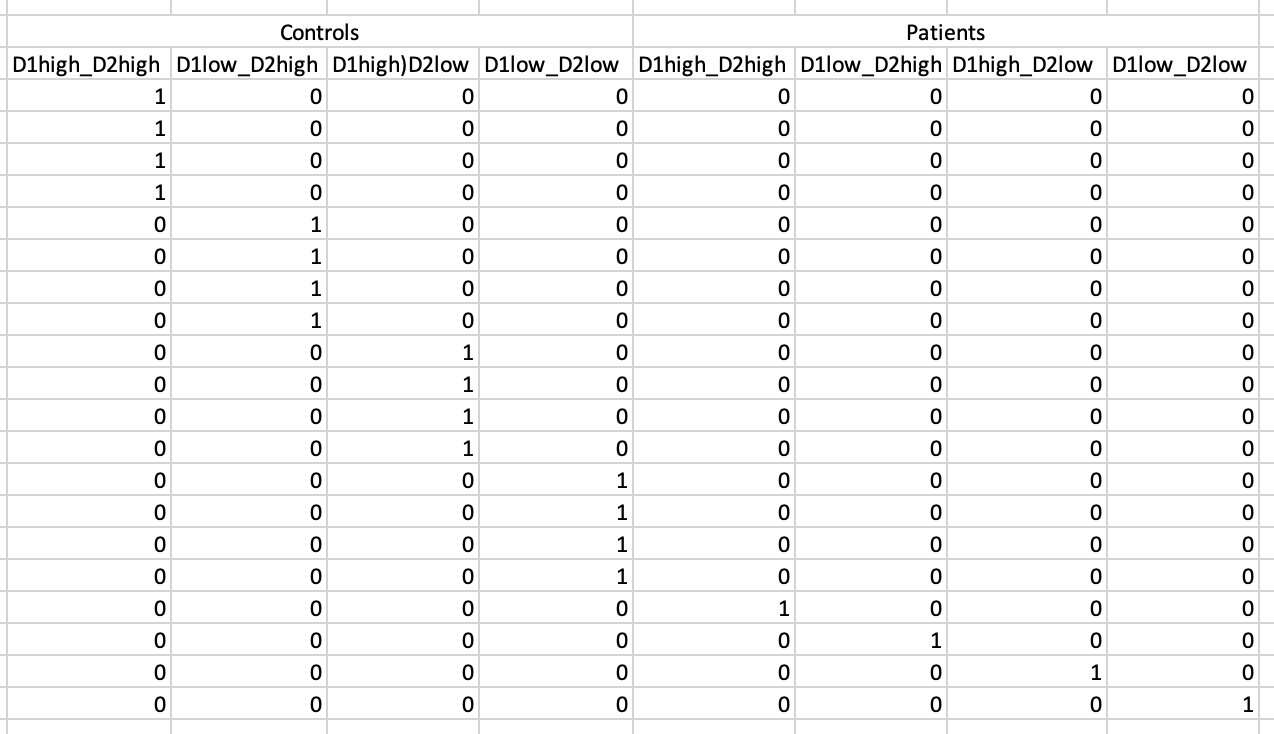
Now my question is how I need to define my contrasts. We have some hypotheses:
-
Controls > patients in general, so then the contrast should be: 0.25 0.25 0.25 0.25 -0.25 -0.25 -0.25 -0.25. Am I right?
-
There is a difference between the 4 groups, where we hypothesize that D1low_D2low > D1high_D2high, with D1low_D2high and D1high_D2low in between (but no hypothesis on the order). Should I run separate tests for this? Any suggestions on how to do that?
-
There might be an interaction effect, where the effect described above is bigger for the patients than for the controls. Any suggestions on how to do that?
Is its feasible at all to do this with fixelcfestats?
Any help would be much appreciated!