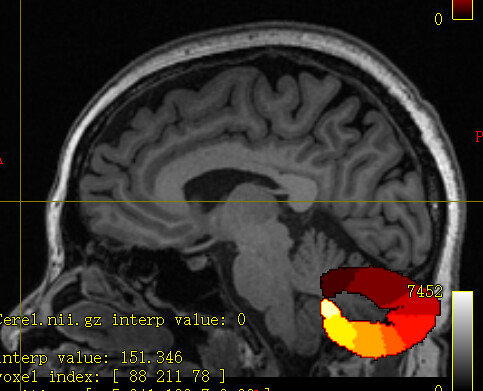
How to register the SUIT cerebellar parcellation template to the individual T1 space?“This is the registration code I previously used with FSL, but the results were not very good. Can anyone help me? Thank you.”
The domain seems to have converged on the conclusion that a 12DoF affine transformation between an individual subject and a population template is inadequate and non-linear registration is required. However the discrepancy that you show is quite gross in magnitude. Non-linear registration is supposed to refine subtle discrepancies in brain shape that can’t be parameterised with a global affine transform, not correct for gross misalignment in upstream linear registration. So I would suggest focusing on getting the linear registration working reasonably before trying to correct an error of that size with non-linear registration.
Firstly, check the output image from the initial flirt registration call. If those do a poor job of aligning anatomy, then obviously anything you do downstream of that is also going to be misaligned, but it’s just complicating the problem.
I note that the individual subject image you are making use of is called “*_brain”, but the image shown in mrview is in fact not brain-extracted. Whereas “MNI152_T1_1mm_brain.nii.gz” I’ve a feeling is brain extracted. The misalignment that you show is to me the kind of result that could arise from providing the registration algorithm with two images, one brain-extracted and the other not, wherein it finds a minimum of the cost function that it is trying to optimise by aligning the outer surface of the extracted brain of the former with the outer surface of the skull of the latter. Ie. The extracted brain is being enlarged until its outer surface is of a comparable size and shape of the skull of the non-brain-extracted image.
So you should either brain-extract both, or neither.
Personally I prefer to specify mask / weights images to control which voxels contribute to the registration cost function vs. not, as the zero-filling from brain extraction can’t be reverted and can have deleterious effects on interpolation.